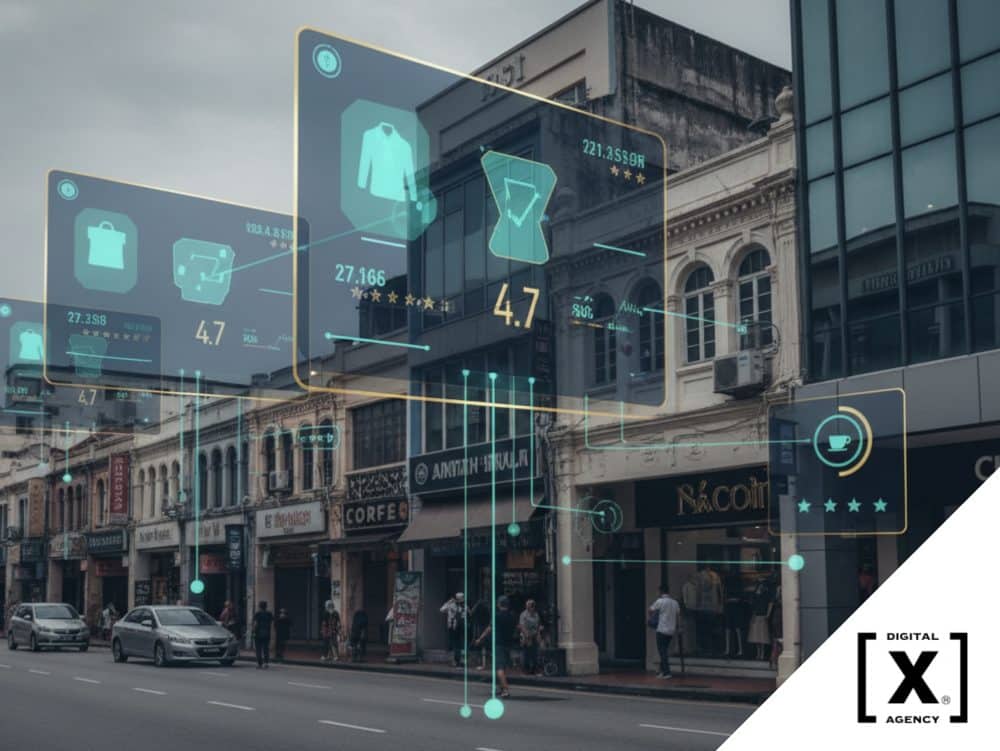


Agentic Commerce Malaysia: Is Your Business Ready for AI Shopping Agents?
In June 2026, Mastercard switched on authenticated AI-agent payments in two markets: Singapore and Malaysia. Not the US. Not the UK. ASEAN first — specifically the JB-Singapore corridor. That same month, AEON360 is deploying AI shopping agents in Kuala Lumpur through a multi-year partnership with Google Cloud, with support for the Universal Commerce Protocol (UCP). Agentic commerce Malaysia is not a trend for 2027. It is infrastructure going live this month. The question for Malaysian businesses right now is not whether AI shopping agents will matter — it is whether your products and services are discoverable to them when they do.
What Agentic Commerce Is — and Why It Changes Digital Marketing
Agentic commerce describes a shopping model where AI agents act as autonomous decision-makers on behalf of consumers. Instead of a buyer manually searching Google, opening five tabs, comparing products, and completing a checkout, an AI agent interprets their goal — “buy running shoes under RM300 that match the jacket I ordered last week” — and executes the entire process. It scans multiple platforms, evaluates products against the stated constraints, compares prices, and completes the purchase through secure payment APIs, all without the consumer returning to a search results page.
At its core, agentic commerce combines human intent with AI-driven execution. The consumer defines the goal. The agent handles the research, evaluation, and transaction. According to Yoast’s analysis of the emerging category, over 60% of consumers already expect to use AI in their shopping journey by 2026 — and McKinsey estimates that agentic commerce could orchestrate up to $1 trillion in US B2C retail revenue by 2030, with global projections reaching $3–5 trillion. The same research found that 44% of users who have tried AI-powered search now call it their “primary and preferred” source over traditional search engines.
For digital marketers, agentic commerce shifts the fundamental question. Traditional SEO and paid search ask: “How do I rank when a human types a query?” Agentic commerce asks: “How do I appear when an AI agent is running a multi-source product evaluation on behalf of a consumer?” Those are different problems. They require different solutions.
Why Agentic Commerce Malaysia Is Starting Right Now
Two live deployments confirm this is not theoretical in Malaysia.
Mastercard Agent Pay — Malaysia and Singapore, June 2026. Mastercard launched its AI-agent payment infrastructure with Singapore and Malaysia as its first two ASEAN markets, using DuitNow and PayNow as the real-time payment rails. This is the payment layer that allows AI agents to complete authorized transactions on behalf of consumers. Malaysia’s mobile-first consumer base and mature real-time payment infrastructure are specifically cited as the reasons for the early ASEAN rollout — not a later phase.
AEON360 + Google Cloud — Kuala Lumpur, April 2026. AEON360 announced a multi-year agentic commerce roadmap anchored in Malaysia, powered by Google Cloud. The deployment uses Google’s Universal Commerce Protocol (UCP) and is building AI agents capable of processing voice, text, and image inputs to build shopping carts and complete authorized purchases. This is the first significant agentic commerce infrastructure deployment in the JB-Singapore corridor’s largest retail brand.
In addition, Malaysia’s e-commerce market reached MYR 147.9 billion in 2025 — projected to MYR 161.8 billion in 2026 (GlobalData, April 2026). That market is now developing the payment rails and commerce protocols to support AI-agent transactions. For brands in that market, the question of AI-agent discoverability is already material.
How AI Agents Actually Find Products
Here is where agentic commerce diverges sharply from traditional digital marketing. AI shopping agents do not type keywords into a search engine. They query structured data sources, product APIs, commerce protocols, and AI-indexed product feeds. Therefore, the primary way to be “found” by an AI shopping agent is through machine-readable product data — not SEO-optimized copy alone.
The 2026 technical standard for AI shopping citation (used by ChatGPT Shopping, Google AI Overviews, and Gemini) is schema.org Product markup. An AI agent evaluating running shoes compares products based on structured data fields — not by reading your product description paragraph. Specifically, the fields most relevant to AI shopping agent evaluation are:
- name, description, image — minimum 1200×800px for AI multimodal extraction
- brand — entity-consistent with your Organization schema
- gtin or mpn — unique product identifier for cross-platform matching
- Offer block — price, currency, availability, and return policy
- AggregateRating — AI agents weight social proof signals in evaluation
- ProductGroup with hasVariant — for multi-variant catalogs (sizes, colors)
The Universal Commerce Protocol and Agentic Commerce Protocol (ACP) — the emerging standards for agent-to-merchant communication — extend beyond on-page schema into merchant APIs and product catalog feeds. However, for most Malaysian businesses, on-page Product schema is the immediate, actionable step that requires no platform integration.
For a deeper technical foundation on schema markup and how AI citation works for Malaysian websites, our guide to schema markup for AEO covers the implementation layer in detail.
What Your Business Needs to Be AI-Agent Discoverable
Three layers determine whether an AI shopping agent can find, evaluate, and recommend your product or service.
Layer 1 — Structured product data on your website. If you’re on Shopify, WooCommerce, or a custom e-commerce site, your product pages need Product schema with all required fields completed. Most platforms generate some schema automatically, but the key fields — AggregateRating, gtin/mpn, and return policy — are typically incomplete on default setups. Audit your schema against the AI citation checklist above. Use Google’s Rich Results Test to validate.
Layer 2 — AI crawler access. AI shopping agents send their own crawl bots. GPTBot (OpenAI), Googlebot-extended, and PerplexityBot must be able to access your product pages. Check your robots.txt file to confirm none of these are blocked. Many Shopify themes and WordPress security configurations block non-Google bots by default — silently excluding you from AI agent consideration regardless of your content quality.
Layer 3 — Entity consistency. AI agents evaluate brands across multiple sources simultaneously. Your product name, business name, address, and contact information should be consistent across your website, Google Business Profile, local directories, and any marketplace listings. Inconsistency reduces agent confidence in your entity — and lowers the probability of recommendation.
These three layers connect directly to the broader AEO strategy we outlined in our guide to AEO for Malaysian and Singapore businesses — agentic commerce discoverability and AI search citation share most of the same technical foundation.
The Marketplace Gap — What Shopee and Lazada Sellers Need to Understand
Here is an important qualification for Malaysian sellers primarily operating on Shopee and Lazada: as of June 2026, neither Shopee nor Lazada has publicly committed to the Universal Commerce Protocol or Agentic Commerce Protocol. Their product data lives inside closed marketplace systems that AI shopping agents cannot directly query. This means a business that sells exclusively on Shopee and Lazada — with no owned-channel website — is structurally invisible to AI shopping agents operating outside those platforms.
This is not a reason to abandon marketplace selling. Shopee and Lazada remain the dominant channels for Malaysian consumer purchases. However, it is a reason to build an owned-channel product presence alongside marketplace listings — even a Shopify store or a well-structured product page on your existing website. That owned presence, with proper Product schema, is your bridge to agentic commerce discoverability.
For the JB-Singapore corridor, this gap is an opportunity. Cross-border buyers increasingly use AI assistants for product research before purchasing. A Malaysian brand with a properly structured, schema-complete product page will appear in those AI evaluations. A marketplace-only brand will not.
What Malaysian Marketers Should Do This Month
Agentic commerce agentic commerce Malaysia is at an infrastructure stage — the rails are being built, not yet mainstream. However, in addition to the Mastercard and AEON360 deployments, consumer adoption of AI shopping tools is accelerating. Furthermore, the businesses that establish AI-agent discoverability in 2026 will compound that advantage as adoption scales.
The agentic commerce Malaysia opportunity is clearest for businesses with owned digital channels — a Shopify store, a properly structured service website, or a product catalog with complete schema. For those businesses, the technical groundwork for AI-agent discoverability and for AI search citation (AEO) is almost entirely the same. You are not building two separate strategies. You are building one structured, entity-clear digital presence that serves both human searchers and AI agents.
Three actions for this month:
- Audit your Product schema. Check whether your product pages output structured data. If you’re on Shopify, install the Schema Plus for SEO or Yoast for Shopify app. If on WooCommerce, Rank Math or Yoast handles Product schema with the WooCommerce add-on. Confirm you’re outputting the 6 key fields listed above.
- Check your robots.txt for AI crawl blocks. Visit yoursite.com/robots.txt and confirm GPTBot, ClaudeBot, and PerplexityBot are not blocked. Fix any disallow directives for these agents.
- Build or validate your owned-channel product presence. If you sell exclusively on Shopee or Lazada, create a minimum viable product page for your top 5 products on your own domain. This is your agentic commerce entry point — and it doubles as an AEO asset for organic AI search citations.
Agentic commerce is not a single moment of disruption — it is an ongoing shift in how products are discovered, evaluated, and purchased. Malaysian businesses that prepare the technical foundation now will hold a material advantage as AI agent adoption accelerates through 2026 and 2027.
The timeline expectation is realistic: most consumers are not yet delegating purchases to AI agents today. However, product discovery is already shifting. Consumers are using ChatGPT, Gemini, and Perplexity to research purchases before they ever open a marketplace app or type a Google query. For example, a buyer considering a standing desk in JB may ask ChatGPT for a comparison of local brands — and if your brand has no structured product data, you are simply not in that comparison. The path from AI discovery to purchase is shortening with every month of agent infrastructure deployment. As a result, the businesses that build structured product data today are building brand presence in AI responses that will drive revenue well before agentic checkout becomes mainstream.
For Malaysian e-commerce businesses and digital marketers, the strategic framing is straightforward: agentic commerce Malaysia is an extension of AEO, not a separate discipline. The same structured data, entity clarity, and content quality that help you appear in Google AI Overviews will help you appear in AI shopping agent evaluations. One investment. Two forms of AI visibility. Build it now, before every agency in JB starts offering it as a new service.
Want to build your AI-agent discoverability strategy? Xwork’s RANK GENERAL protocol now includes AI search visibility as a core component alongside SEO — structured to make your brand findable by both human searchers and the AI agents buying on their behalf.
