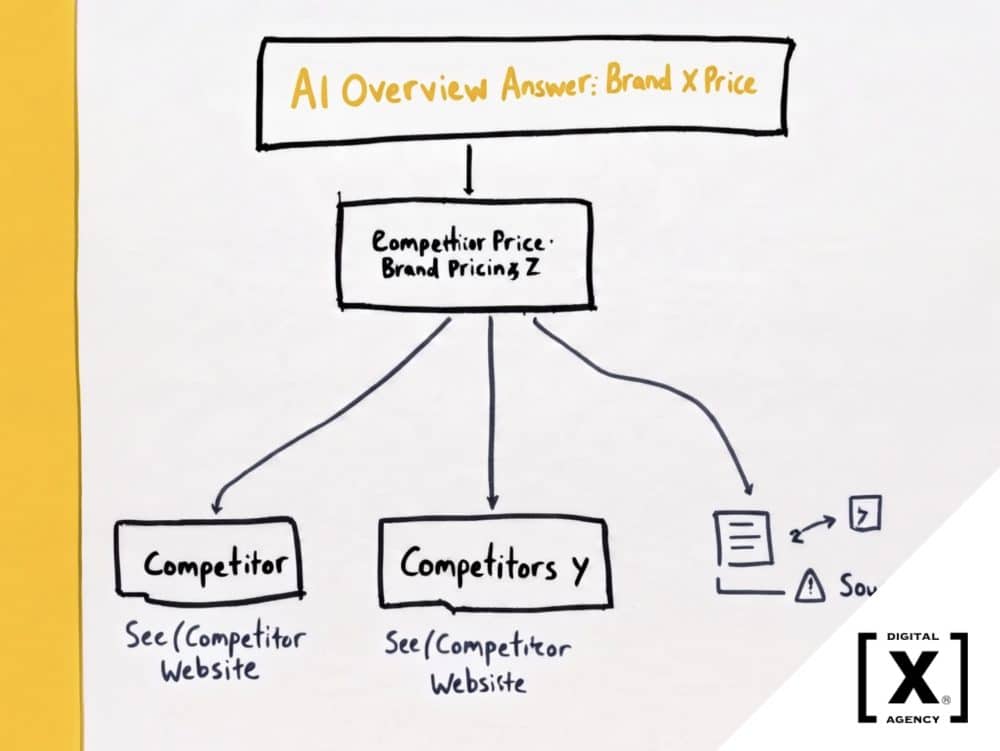


Your brand name does not reserve the answer box. Competitor citations in AI Overviews can put a rival’s page inside an answer to a search that names your business.
That is worth checking, but not panicking about. A buyer asking for alternatives wants other options. A buyer asking about your fees deserves an accurate answer about you. The useful defence is not to flood Google with more posts. It is to publish clear buying information, then check whose sources Google actually uses.
For Malaysian businesses serving Johor Bahru, KL or Singapore, start with pricing, scope and proof. Your sales team already answers these questions. They give you a place to improve without pretending overseas research measures your market.
What Are Competitor Citations in AI Overviews?
Competitor citations in AI Overviews are supporting links to a rival’s own website inside Google’s AI-generated answer. The query names one brand, but Google draws part of its answer from another business in the same category.
A source is not the same as a recommendation
For example, imagine someone searches for “Brand A accounting software pricing”. The answer links to Brand B’s article explaining Brand A’s fees. That is a competitor citation. It does not, by itself, mean Google tells the buyer to choose Brand B.
Therefore, keep three signals separate:
- Mention: the answer names a business.
- Citation: the answer links to a source page.
- Recommendation: the answer explicitly suggests a choice for the buyer.
Our guide to the AI recommendation gap covers that final step. Here, the question is narrower: who supplies the evidence when someone searches for your brand?
Why your homepage is not enough
A homepage introduces the business. However, it rarely answers each question about price, terms, limits or switching costs. A focused rival page can address one of those questions more directly.
Google says AI Overviews and AI Mode can use related searches to build an answer. Therefore, the sources do not have to stop at your homepage or the exact words in the original query. This is still search, not proof that an AI has formed a permanent opinion about your business.
The Data Behind the Problem
Foundation’s research shows competitor citations in a repeated B2B software sample, not a measured rate for Malaysian businesses. Its October 2026 study with Writesonic analysed 15,716 Google AI Overviews generated from 1,235 prompts across 13 weekly runs, from 29 June to 21 September.
What the headline numbers actually mean
A direct competitor’s website appeared as a source in 21.7% of those AI Overviews. In 11.9%, a competitor appeared as a source while the searched brand’s own site did not. Those are different measures. The larger number does not mean the searched brand disappeared.
Likewise, 15,716 answers are not 15,716 unique questions or people. The study repeated a smaller prompt set over time. That helps show change, but it does not turn the results into a customer survey.
What the study cannot tell a Malaysian owner
However, the sample covers B2B SaaS buying questions. The article does not disclose a search locale or provide a Malaysian breakdown. Foundation and Writesonic also sell services or tools in this market. Their disclosed method is useful; their findings still need context.
Moreover, competitor citation rates ranged from 12.7% to 30.2% across weekly runs. One screenshot is a snapshot, not a stable market share. The research does not establish Malaysian search demand, lost enquiries or sales caused by a citation.
Use it to choose questions for your own audit. Do not use it to tell a JB business that one in five of its customers sees a competitor. These findings about competitor citations in AI Overviews are a reason to check, not a local loss rate.
The Four Query Types Where You’re Most Exposed
The buying word added to a brand name changes the question, so audit alternatives, pricing, reviews and migration separately. Foundation’s breakdown shows why one headline rate hides important differences.
| Query type | Distinct prompts | Answers citing a competitor | Practical reading |
|---|---|---|---|
| Alternatives | 541 | 35.8% | The buyer explicitly wants other choices. |
| Pricing | 298 | 13.4% | Clear first-party fee information matters. |
| Reviews | 377 | 7.8% | Check the evidence behind claims. |
| Migration | 19 | 26.2% | Small subgroup; an early signal only. |
Source: Foundation B2B Citation Index, powered by Writesonic. Rates describe repeated AI Overview answers within each group, not percentages of Malaysian buyers. A single answer can cite both the brand and a competitor.
Alternatives are a comparison, not an attack
Alternatives account for 541 of the 1,235 prompts—about 44% of the set. Consequently, the overall rate includes many searches that invite competition. Calling every rival citation a hijack misreads the buyer’s intent.
Instead, publish an honest fit guide. Explain where your service works well and when another option makes more sense. If you name competitors, verify their current offers and disclose your commercial interest.
Pricing and reviews are the stronger defensive starting point
The searched brand’s own site appeared in 75.7% of pricing answers and 61.4% of review answers in the study. In other words, first-party sources still had a substantial presence.
For a Malaysian service business, translate these categories into real questions: “Does the monthly fee include setup?”, “Is there a minimum term?” and “What evidence supports this claim?” For cross-border buyers, state the billing currency and service area plainly.
Migration needs its own evidence
Meanwhile, switching questions concern disruption, data, ownership and handover. However, the migration group contained only 19 distinct prompts. Treat its 26.2% rate as exploratory, not a reliable forecast for your industry.
How to Audit Your Branded AI Search Visibility Right Now
Audit a fixed list of real buying questions and save the answers, rather than checking your brand name once. This extends a basic AI search visibility audit into a source-level check of your commercial information.
Build the query list from sales conversations
First, take questions from recent enquiries, proposals and calls. Choose six to ten that buyers genuinely ask. Use your brand name with pricing, reviews, alternatives, contract terms and switching questions where relevant.
Then run them in Google Search from your target market. Keep English, Bahasa Malaysia and Chinese checks separate if those reflect your customers. For a JB–Singapore business, record the country used for each check rather than merging all results.
These are proposed audit steps, not results from a local study. We have not tested your brand by writing this article.
Record the source, the claim and the outcome
For each query, save:
- The exact wording, date, language and search location.
- Whether an AI Overview appears at all.
- The complete answer and every visible supporting URL.
- Whether your site, a rival or a third party supplies the source.
- Any wrong price, stale term or unsupported claim.
- Any explicit recommendation, logged separately from citations.
However, an absent AI Overview is not a failed citation. Record “no AI Overview shown”. Likewise, do not combine Search, AI Mode and ChatGPT into one score. Their answers and source sets differ.
Repeat before you prioritise
Then repeat the same queries across several dates. If a rival source keeps appearing, inspect the exact page and identify the question it answers better. Then fix that gap before commissioning a new content series.
Fix wrong facts first, missing answers next and harmless rival mentions last. Also compare the findings with real enquiries. A count of competitor citations in AI Overviews helps you find gaps. It does not tell you who bought or why.
For example, use this simple rule when you read each answer: is it wrong, incomplete or just not yours? A wrong fee needs a fix. A fair link to a rival in an alternatives answer does not. This keeps a small team focused on work that helps the buyer, rather than a score that looks good in a report.
Five Strategies to Win Back Your AI Citation Territory
Improve the buying answers you control before trying to displace every competitor source. The goal is accurate, useful evidence—not exclusive ownership of a search result that belongs to the buyer.
1. Make pricing useful even when it is custom
State your starting price or explain the factors that set the quote. Also list what the fee includes, what costs extra and how long the commitment lasts. Date the information and assign someone to maintain it.
For example, a MY–SG service page should distinguish MYR billing from SGD billing. If media spend, software fees or taxes sit outside the retainer, say so beside the price. A clear explanation is more useful than “contact us” on its own.
2. Publish a fair comparison and fit page
Explain the trade-offs a buyer should weigh, including reasons not to choose you. Compare the same scope, contract length and cost basis. Furthermore, link to original vendor information when discussing another business.
This is not permission to invent negative claims or manufacture “independent” reviews. A disclosed commercial comparison is more credible than a fake neutral ranking. Keep the page focused on a real buying decision.
3. Replace broad claims with checkable proof
Use approved client examples with a clear time period, starting point and measured outcome. Where you lack results, explain your process and limits. Do not rename a benchmark as a case study.
Also, keep business profiles on other sites up to date. Ask for real reviews without scripts or paid praise. A quote on your own site is evidence you chose to show. Do not pass it off as a review from a neutral source.
For instance, a proof page can state the job, the dates and the result in plain words. Show what changed and how you checked it. If the client has not agreed to share their name or figures, leave them out. A small, true claim beats a bold one you cannot back up.
4. Fix retrieval basics, not imaginary AI requirements
Make the answer accessible as text, link it from relevant pages and check its indexing status in Search Console. Also ensure that any structured data matches what visitors see.
Google Search Central is explicit:
“There are no additional requirements to appear in AI Overviews or AI Mode, nor other special optimizations necessary.”
Google requires supporting pages to be indexed and eligible for a search snippet. It does not require a special AI file or schema type. Nor does meeting those requirements guarantee inclusion.
Keep the scope clear when discussing agentic search, too. A supporting source in an AI answer is not evidence that an agent can complete a booking or purchase.
5. Turn recurring errors into a monthly content queue
Next, give each gap a page owner, a fix and a review date. Start with one pricing update, one proof page or one comparison—not twenty generic posts. Then rerun the same queries and record what changed.
However, a new source link after an edit does not prove the edit caused it. Keep a dated change log and look for the same pattern more than once. Meanwhile, track good leads on their own. Do not turn a search gain into a sales claim without proof.
Give the first month a tight scope: check the same query list, fix one weak page and save what you changed. At the next check, compare like with like. If nothing has changed, say so. That is still a useful result, because it tells the team not to claim a win.
In short, competitor citations in AI Overviews deserve a measured response. Know the question, check the source and fill the gap. You do not need to own every link to give buyers a clear, fair view of your offer.
FAQ
Competitor citations are a source-selection issue, not automatic proof that you lost a customer. These answers set the limits for a useful audit.
Can competitors appear in AI Overviews for my brand name?
Yes. Google can cite a competitor’s page when answering a query that names your brand, especially when the question asks about alternatives, pricing or reviews. A competitor citation does not automatically mean Google recommends that competitor.
Does the 21.7% competitor citation rate apply to Malaysia?
No. Foundation’s figure describes 15,716 AI Overview answers from repeated B2B SaaS prompts. The study does not provide a Malaysian breakdown or disclose a search locale. Use it to guide an audit, not as a Malaysian benchmark.
Can I stop Google citing competitors for my brand?
You cannot reserve an AI Overview or prevent Google from citing a legitimate competitor source. Publish accurate buying information on your own site, correct misleading claims through appropriate channels, and monitor recurring source patterns.
Do I need special schema or llms.txt to appear in AI Overviews?
No. Google says there are no additional technical requirements or special schema types for AI Overviews. A supporting page must be indexed and eligible for a search snippet. Helpful content and sound SEO remain the starting point, without a guarantee of inclusion.
When buying help, pay for the work and evidence rather than an acronym. Our GEO pricing guide explains the bundled-versus-add-on distinction. Xwork’s Rank General SEO and AI-search engagement includes both SEO and GEO within one retainer. Start a conversation with Xwork about a focused branded-search audit, then prioritise the gaps that matter to your buyers.
