


Understanding the Difference
In modern Meta advertising (Facebook and Instagram Ads), marketers frequently encounter two related concepts, understanding the difference and why both matter for high-performance advertising is strategically crucial and relevant for the eventual success of the ads.
- Audience Research
- Avatar Research (Customer Persona Research)
While these terms are often used interchangeably, they actually represent two different layers of marketing intelligence.
Understanding how these two research approaches differ — and how they work together — can significantly improve:
- Meta Ads targeting
- Creative performance
- Engagement rates
- Conversion rates
- Ad scaling potential
This article explains the key differences between audience research and avatar research, how they influence Meta Ads performance, and why avatar research has become increasingly important in the age of AI-driven advertising.
What Is Audience Research?
Audience research focuses on identifying broad groups of people who are likely to be interested in your product or service.
It answers the question: “Who is the potential market for this offer?”
Audience research typically includes:
• Demographics (age, gender, income)
• Geographic location
• Interests
• Occupations
• Buying behaviors
• Device usage
• Lifestyle indicators
In Meta Ads, this information helps advertisers define:
• Interest targeting
• Lookalike audiences
• Geographic targeting
• Behavioral segmentation
• Custom audiences
Example
A fitness brand might identify a target audience such as: Women aged 25–34 interested in yoga and wellness. This tells the advertiser who the ads should be shown to. However, it still lacks deeper emotional insight. That deeper understanding comes from avatar research.
What Is Avatar Research (Persona Research)?
Avatar research goes far beyond demographics. Instead of defining a group, it defines an individual representation of the ideal customer.
A customer avatar typically includes:
- Name
- Age
- Lifestyle
- Goals
- Motivations
- Pain points
- Fears
- Aspirations
- Daily routines
- Language patterns
In other words:
Avatar research answers the question: “What is happening inside the customer’s mind?”
Example Avatar
Instead of targeting: “Women 25–34 interested in yoga”
Avatar research might create a persona such as:
Sarah, 29
- Busy working mother
- Feels stressed balancing work and family
- Wants quick 15-minute home workouts
- Searches for ways to reduce anxiety and boost energy
Now the marketing message can speak directly to her situation.
Key Similarities Between Audience Research and Avatar Research
Although they operate at different levels, both research approaches serve similar strategic goals.
1. Improving Ad Performance
Both methods help increase:
- Engagement
- Click-through rate
- Conversion rate
Because the messaging becomes more relevant.
2. Understanding Customer Behavior
Both rely on analyzing patterns such as:
- Interests
- Consumer habits
- Purchase triggers
- Market trends
3. Supporting Creative Strategy
Both types of research influence:
- Ad messaging
- Creative concepts
- Campaign strategy
- Targeting structure
In AI-driven advertising environments, both also help guide the algorithm toward better customers.
The Key Differences: Scope vs Granularity
The most important difference between audience research and avatar research is granularity. Put simply: Audience research identifies the market. Avatar research identifies the motivation.
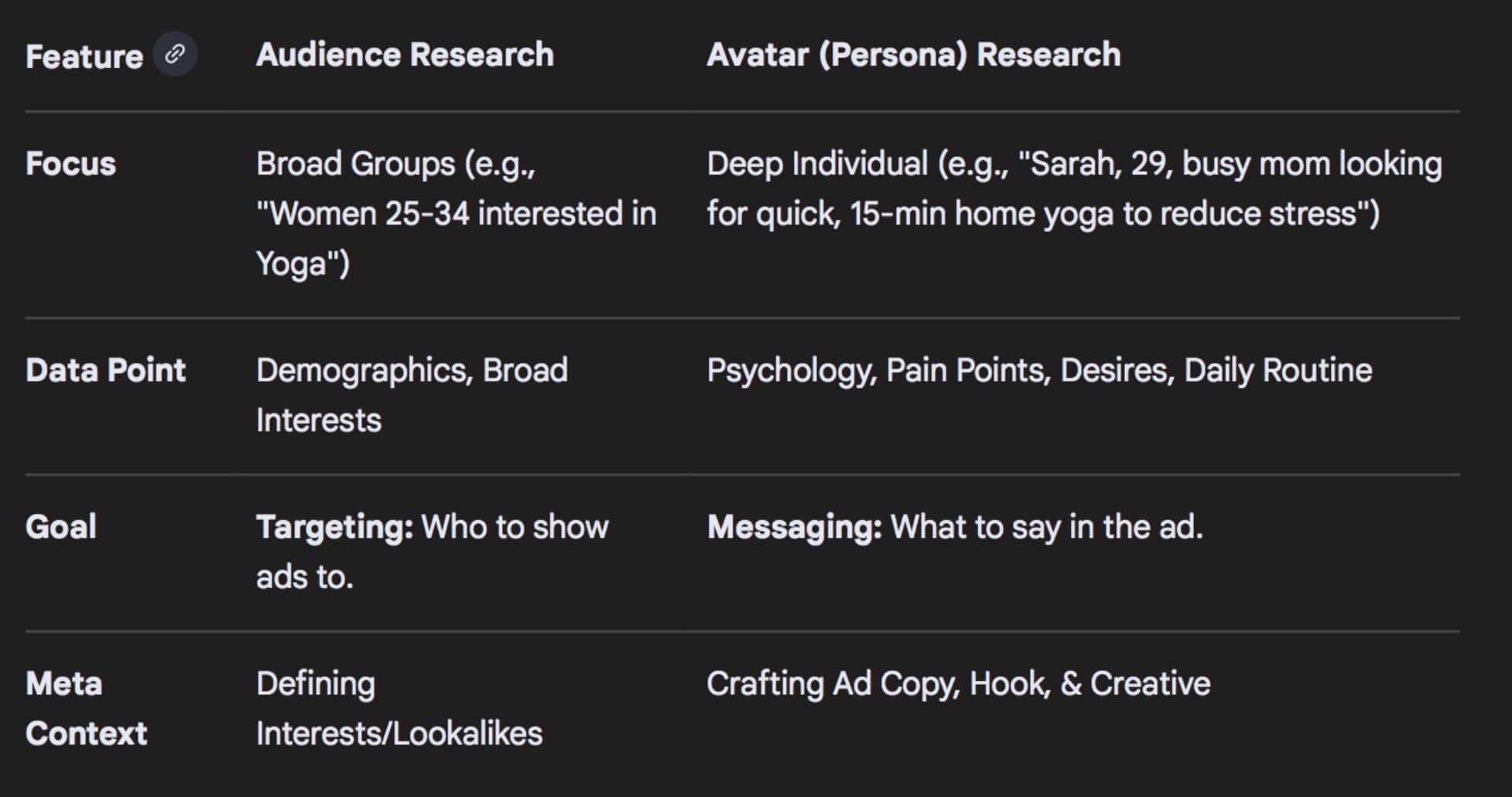
How Avatar Research Informs Meta Ads
Avatar research acts as a deeper psychological layer within your marketing strategy. It answers questions that basic targeting cannot.
1. Psychological Drivers
What keeps your customer awake at night?
These insights help create powerful pain-based hooks, such as:
- Problem-solution messaging
- Emotional storytelling
- Relatable frustrations
Example: “Struggling to find time to exercise between work and family?”
2. Language Patterns
Customers describe their problems using specific phrases.
Avatar research identifies these phrases so they can be used in:
- Ad headlines
- Video scripts
- Landing pages
- Sales copy
Example:
Customer language: “I never have time for the gym.”
Ad copy translation: “No time for the gym? Try this 15-minute routine at home.”
3. Visual Representation
Avatar research also informs creative direction.
Important questions include:
- What lifestyle visuals resonate most?
- Are aspirational images more effective than relatable scenes?
- Does the audience respond better to UGC-style ads or polished brand videos?
These insights guide decisions about:
- Video style
- Ad format
- Creative tone
The Evolution of Meta Ads: Why Avatar Research Matters More Today
Meta’s advertising ecosystem has changed dramatically. Previously, advertisers needed to carefully define target audiences through detailed interest targeting.
Typical workflow:
- Define audience
- Create ads
- Launch campaigns
But with AI-driven targeting such as Advantage+ audiences, Meta increasingly handles audience discovery automatically.
This means advertisers now rely more heavily on creative quality.
Today’s workflow looks more like this:
- Develop strong creative
- Provide signals to the algorithm
- Let AI find the audience
This is why avatar research has become so important. Your creative is now the targeting.
Simple Analogy: Fishing
A useful analogy helps illustrate the difference.
- Audience research tells you where the lake is.
- Avatar research tells you what bait to use.
You need both.
But if the bait is wrong, you won’t catch anything.
Avatar Research Framework for Meta Ads
A practical framework helps marketers develop strong avatars. Below is a simplified five-layer avatar model.
⸻
Layer 1: Demographics
Basic profile information:
• Age
• Gender
• Location
• Occupation
• Income
⸻
Layer 2: Lifestyle
Understanding daily behavior:
• Work schedule
• Family life
• Social activities
• Media consumption habits
⸻
Layer 3: Pain Points
Identify frustrations such as:
• Lack of time
• Financial pressure
• Skill gaps
• Health concerns
Pain points are often the core drivers of ad engagement.
⸻
Layer 4: Desired Outcome
Customers don’t buy products. They buy desired futures, such as:
• More free time
• Higher income
• Better health
• Greater confidence
⸻
Layer 5: Emotional Triggers
Strong ads often tap into emotions like:
• Fear
• Aspiration
• Curiosity
• Relief
• Social status
These emotional triggers drive clicks and conversions.
Example: Avatar Research for a Digital Marketing Course
Audience Research
Possible target group:
- Entrepreneurs
- Small business owners
- Marketing professionals
- Age 25–45
Avatar Research
A deeper persona might look like:
Jason, 34
- Runs a small ecommerce store
- Sales fluctuate unpredictably
- Feels overwhelmed by digital marketing
- Wants a simple system to generate leads
Ad Messaging
Instead of a generic ad: “Learn digital marketing today.”
The ad becomes: “Running an online store but struggling to get consistent sales?”
The difference in relevance is dramatic.
10 Questions to Build a High-Converting Customer Avatar
Marketers can use the following questions to develop effective personas.
- What problem is the customer actively trying to solve?
- What frustrations do they experience daily?
- What outcome do they desire most?
- What fears prevent them from achieving it?
- What solutions have they already tried?
- Why did those solutions fail?
- What language do they use to describe the problem?
- Who influences their purchasing decisions?
- What social platforms do they spend time on?
- What transformation do they ultimately want?
These answers become the foundation of high-converting ad copy.
How to Conduct Audience Research for Meta Ads
Effective audience research usually involves several methods.
Market Analysis : Understand industry demand and trends.
Competitor Research : Analyze competitors messaging, target audiences, creative strategies.
Meta Audience Insights : Use Meta tools to identify interest clusters, behavioral signals, demographic distributions.
Customer Data Analysis : Use existing data from CRM systems, website analytics, email lists, purchase history.
How to Conduct Avatar Research
Avatar research requires deeper qualitative insight.
Customer Interviews : Speaking directly with customers reveals emotional motivations.
Reviews and Testimonials : Product reviews often contain valuable language patterns.
Online Communities : Platforms like forums and social communities reveal honest frustrations.
Sales Conversations : Sales calls often expose objections, doubts, and motivations.
Customer Support Data : Support requests highlight real-world pain points.
How Avatar Research Improves UGC Ads
User-Generated Content (UGC) ads perform well on Meta because they feel authentic and relatable.
Avatar research helps UGC creators:
• Speak in the customer’s language
• Highlight relatable struggles
• Demonstrate realistic outcomes
Example UGC hook: “As a small business owner, I was struggling to get consistent leads…”
This works because it mirrors the customer avatar.
⸻
Combining Both Research Approaches for Maximum Results
The most successful advertisers combine both research layers.
Step 1: Audience Research
Identify the broader market segment.
Step 2: Avatar Research
Develop detailed customer personas.
Step 3: Creative Development
Craft ads that speak directly to those personas.
Step 4: Algorithm Optimization
Allow Meta’s algorithm to find similar users.
This approach balances:
• Human psychology
• AI optimization
⸻
Final Thoughts
Audience research and avatar research are not competing concepts. They are complementary tools within a sophisticated advertising strategy.
In today’s AI-driven Meta advertising environment:
• Audience research defines the market
• Avatar research defines the message
Advertisers who master both gain a powerful advantage.
Because in modern advertising, success often comes down to a single factor: How deeply you understand your customer.
