


Hook Matrix & The 3-Second Rule
In the fast-scrolling world of social media advertising, attention is the most valuable currency. On platforms like Facebook and Instagram, users decide within seconds whether to keep watching your ad or scroll past it. This is where the Hook Matrix becomes one of the most powerful creative frameworks in performance marketing.
The concept is simple but incredibly effective: instead of relying on a single opening line, marketers create multiple high-impact hooks across several psychological angles, then systematically test them against audiences.
For brands running UGC (User Generated Content) ads on the Meta platform, mastering the Hook Matrix can dramatically improve:
- Click-through rates (CTR)
- Video watch time
- Engagement signals
- Conversion rates
- Cost per acquisition (CPA)
In this article, we will break down:
- What the Hook Matrix is
- Why hooks matter more than ever in Meta ads
- The 7 high-converting hook types used by top ad agencies
- How to build your own Hook Matrix framework
- Practical examples for UGC ads
What Is the Hook Matrix?
A Hook Matrix is a structured system used by advertisers to generate and test multiple opening hooks for short-form video ads. Instead of creating one ad creative, marketers create a matrix of hook variations, each targeting a different psychological trigger.
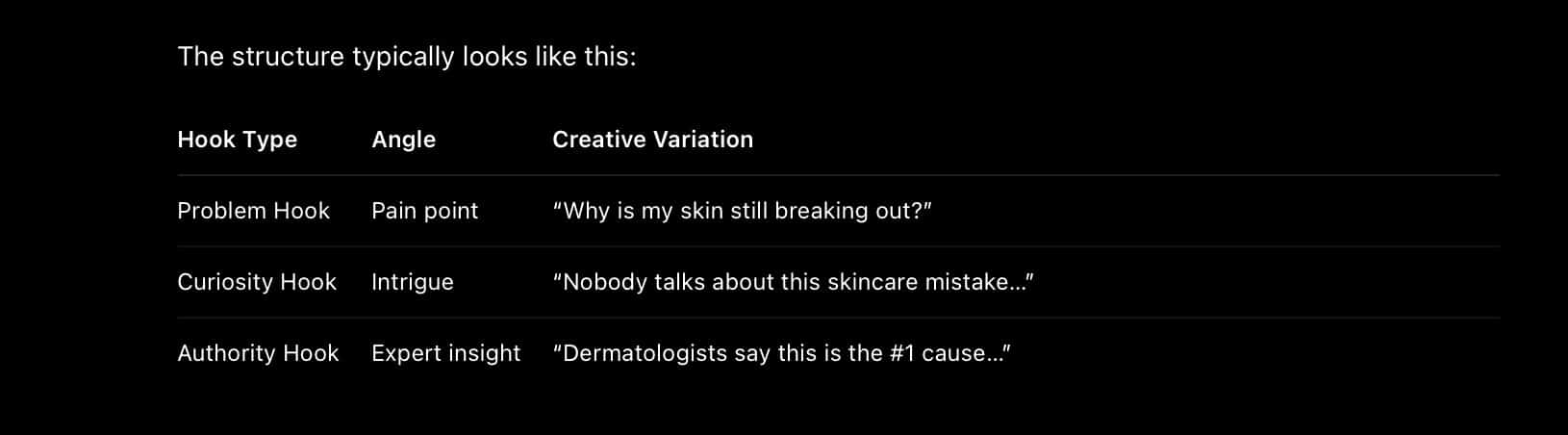
By testing multiple hooks against the same product message, advertisers quickly discover which narrative resonates most with their audience.
In performance marketing circles, the rule is simple: The hook is responsible for 80% of an ad’s performance. If the first 3 seconds fail, the rest of the ad rarely matters.
Why Hooks Matter More on Meta Today
Over the past few years, Meta’s algorithm has shifted heavily toward short-form video and engagement signals.
With the rise of:
• Facebook Reels
• Instagram Reels
• AI-driven ad delivery
• Scroll-based consumption
Ads now compete directly with organic content.
That means traditional ad formats are no longer enough. The best performing ads today feel like native content, not commercials. This is why UGC-style ads dominate the Meta platform.
UGC ads typically feature:
• Casual camera angles
• Real people or creators
• Conversational language
• Authentic storytelling
But even the most authentic video will fail if it doesn’t capture attention instantly. The Hook Matrix ensures that every ad begins with a compelling entry point.
The 7 High-Converting Hook Types (UGC Ads)
Below are the seven hook formats used by high-performing Meta ad agencies when producing UGC creatives. Each one triggers a different psychological response.
1. The Problem Hook
The Problem Hook immediately calls out a frustration the audience experiences. This creates instant relatability and stops the scroll.
Examples
- “Why is my coffee always going cold before I finish it?”
- “I wasted $300 on skincare before discovering this.”
- “If your back hurts every morning, watch this.”
Why it works
Humans are naturally wired to pay attention to problems that affect them personally. When viewers hear their own pain point, they feel the ad is relevant to them.
2. The Curiosity Hook
The Curiosity Hook creates intrigue by withholding information. It leverages the psychological principle known as the curiosity gap.
Examples
- “Nobody talks about this mistake when buying knives…”
- “This travel bag has a hidden feature most people miss.”
- “I didn’t believe this kitchen hack until I tried it.”
Why it works
Curiosity creates open mental loops. People feel compelled to continue watching until the mystery is resolved.
3. The Shock or Pattern Interrupt Hook
A Pattern Interrupt Hook breaks the viewer’s expectations. It might include surprising statements, unusual visuals, or unexpected facts.
Examples
- “Stop buying expensive knives.”
- “This $20 gadget replaced three kitchen tools.”
- “You’re using your backpack completely wrong.”
Why it works
Social media feeds are repetitive. Anything that breaks the pattern triggers attention.
4. The Authority Hook
The Authority Hook introduces expert knowledge or credibility. This builds trust quickly, especially for higher-consideration purchases.
Examples
- “Professional chefs use knives like this for a reason.”
- “I’ve tested 42 backpacks and this one surprised me.”
- “Marketing agencies don’t want you to know this trick.”
Why it works
People trust authority figures, experts, and data-driven insights. Authority reduces perceived risk.
5. The Story Hook
Story hooks begin with a personal experience or narrative. They are common in authentic UGC ads.
Examples
- “Three months ago I started traveling every week…”
- “I bought this bag before my trip to Tokyo…”
- “I used to hate cooking until I tried this.”
Why it works
Stories trigger emotional engagement. Instead of watching an advertisement, viewers feel they are hearing a personal story.
6. The Demonstration Hook
The Demonstration Hook immediately shows the product in action. Instead of explaining, it visually proves the benefit.
Examples
- Knife slicing through tomato paper-thin
- Bag expanding to double capacity
- Gadget solving a common kitchen problem
Why it works
Visual demonstrations reduce skepticism. Viewers see the benefit instantly and clearly.
7. The Comparison Hook
Comparison hooks position the product against an alternative. This frames the product as the better choice.
Examples
- “I compared this knife to a $300 one.”
- “Here’s the difference between cheap backpacks and this.”
- “Store-bought vs homemade coffee.”
Why it works
Comparisons help viewers process value quickly. It simplifies decision-making.
How Agencies Build a Hook Matrix
Top Meta ad agencies rarely launch a campaign with just one ad. Instead they build Hook Matrices with multiple variations. A typical structure might look like this:
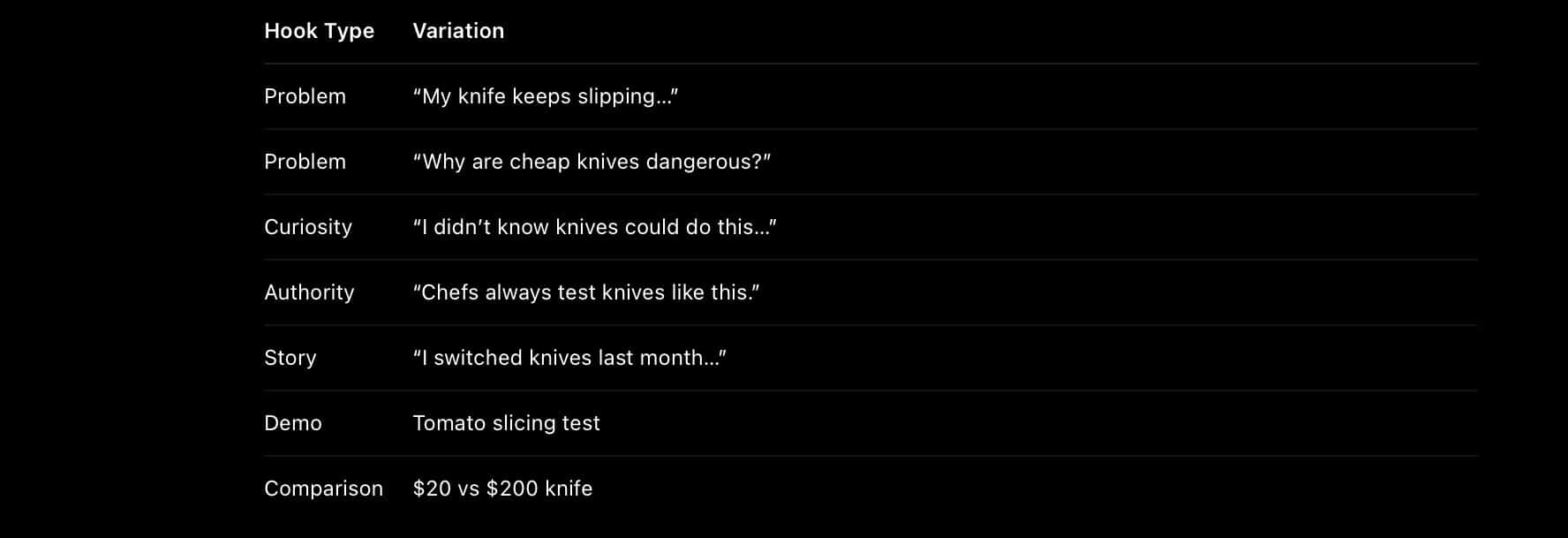
From just one product message, this matrix creates 7–15 ad openings. The algorithm quickly identifies the winners.
The 3-Second Rule in Meta Ads
Most Meta users decide whether to keep watching within three seconds.
Your hook must:
- Capture attention instantly
- Signal relevance
- Create curiosity
If it fails, the ad loses momentum. This is why agencies focus heavily on hook iteration, not just creative production.
UGC Ads and the Rise of Authentic Marketing
One of the biggest shifts in recent years is the dominance of UGC-style advertising.
UGC ads outperform traditional commercials because they:
- Feel authentic
- Look native to social feeds
- Reduce advertising resistance
- Encourage engagement
However, authenticity alone isn’t enough. Even the most natural video still needs a powerful hook. The Hook Matrix ensures every creative starts strong.
Hook Matrix Example for a Travel Bag
Let’s imagine a brand selling a travel backpack.
Here’s how a Hook Matrix might look:
Problem Hooks
-
- “Why do travel bags never fit enough stuff?”
- “I hate carrying two bags at the airport.”
Curiosity Hooks
-
- “This backpack has a feature I didn’t expect.”
- “I didn’t know bags could expand like this.”
Authority Hooks
-
- “Frequent travelers always pack like this.”
Story Hooks
-
- “I bought this bag before my Europe trip.”
Demo Hooks
-
- Showing how the bag expands.
Comparison Hooks
-
- Budget backpack vs premium design.
From just one product, a brand now has multiple creative angles to test.
The Hook Matrix and Performance Marketing
Modern performance marketing is less about perfect ads and more about rapid testing. Instead of guessing what works, marketers launch multiple hook variations and let the algorithm decide. This aligns perfectly with Meta’s ad system.
Campaigns often follow this structure:
- Launch multiple hook variations
- Identify top performers
- Scale winning creatives
- Refresh hooks every 2–4 weeks
Over time, brands develop libraries of high-performing hooks.
The Future of Hooks in AI-Driven Advertising
As AI tools become more advanced, marketers are beginning to generate dozens of hook variations instantly. However, the underlying psychology remains unchanged.
Successful hooks will always rely on:
- curiosity
- relatability
- emotional triggers
- storytelling
- authority
The Hook Matrix simply provides a systematic framework for applying these principles.
Final Thoughts
In the modern advertising landscape, attention is the hardest resource to win. Platforms like Facebook and Instagram move at incredible speed, and brands have only a few seconds to make an impression. The Hook Matrix provides a powerful solution.
By testing multiple psychological angles across UGC creatives, brands can consistently discover which messages resonate with their audience. For performance marketers, the lesson is clear:
Don’t just build ads. Build better hooks. Because in social media advertising, the first three seconds often determine the success of everything that follows.
